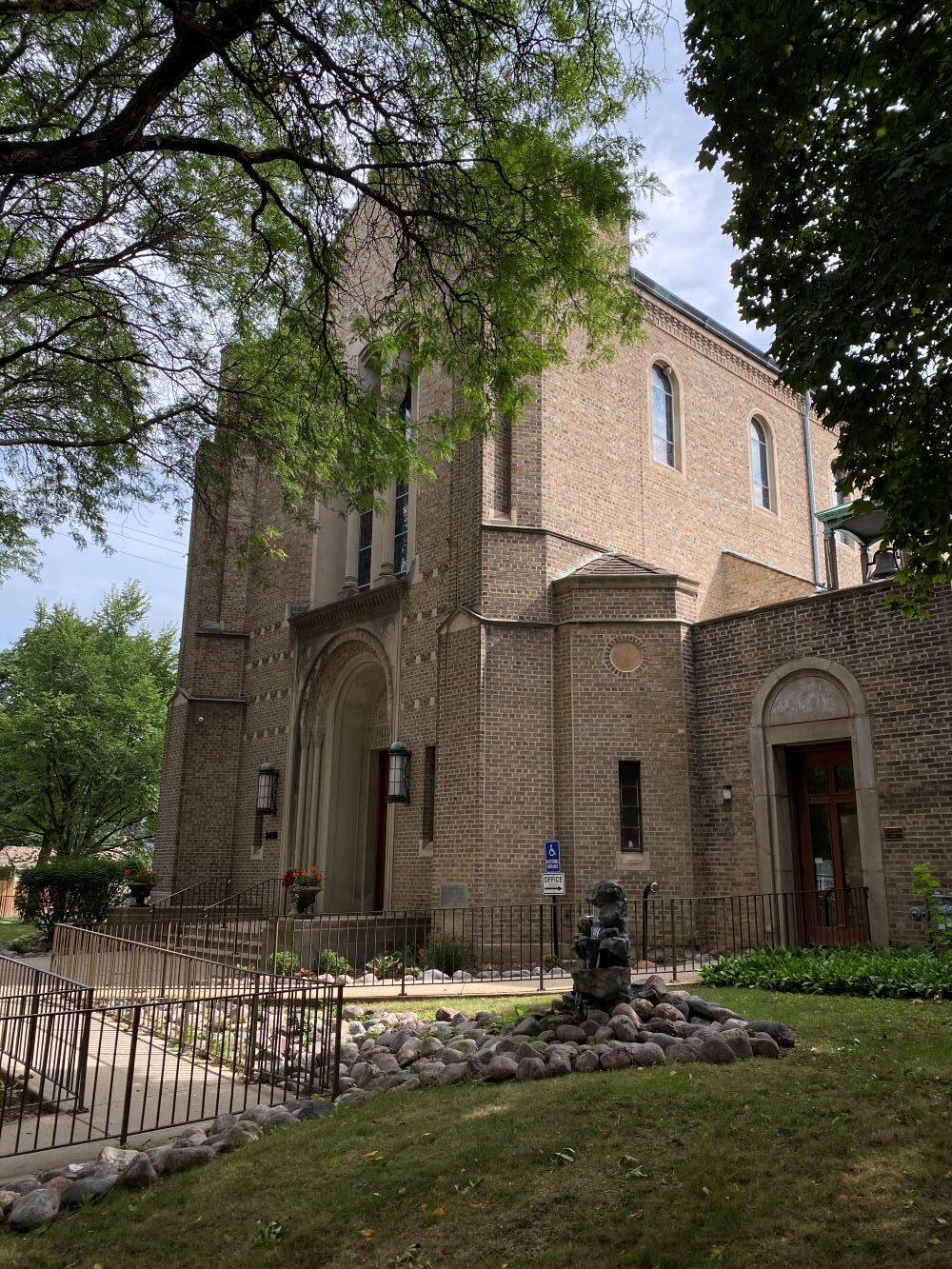

Building Description
3456 North 38th Street is the current home of the Pilgrim Rest Missionary Baptist Church which was established in 1952. After 35-years at our previous church home located at 3737 North Sherman Boulevard, prayers and mission work led us to acquire the former St. John de Nepomuc Parish in 2015. Sharing similar origins of church homes beginning in close proximity of being less than one-mile apart, Pilgrim Rest began at North 9th and West Brown Street and St. John’s at North 4th Street and West Cherry Street.
Designed by congregation member and architect Henry R. Slaby (1906-1995), Slaby took on St. John de Nepomuc as his first church commission. He later designed several other Catholic churches in Milwaukee and its suburbs, including St. Stephen Martyr, built in 1969 located on North 51st Street and Hope Avenue.
St. John de Nepomuc is the last of the Romanesque Revival churches in Milwaukee. Although some architects continued to design Gothic Revival churches into the late 1950s, and the Colonial Revival continued even later, no Romanesque Revival churches have been constructed in the city since World War II. With St. John de Nepomuc, the style went out with a bang rather than a whimper.
The church has a basilican plan with a tall, narrow nave. It is smaller than most churches of the Romanesque period but more in keeping with their proportions. The windows are relatively small and widely spaced, giving the building a more solid and massive appearance. Overall, St. John de Nepomuc is representative of the more academic phase of the historical revival styles that architects developed beginning in the early twentieth century. This phase of revivalist architecture was in part a consequence of new scholarship on historic buildings, including those of medieval Europe. Architects had access to more written and photographic documentation on earlier buildings, and in some cases drawings based on precise measurements. Although this scholarly approach to design is more often seen in the Gothic Revival, St. John de Nepomuc is an excellent example in the Romanesque Revival style.
Upon completing the purchase of the church campus, Pilgrim Rest conducted a full renovation of the sanctuary to make it the new home for the baptist church. Developing new acoustics for the soulful choir music, adding new restrooms, building a baptism pool and making the building ADA accessible added its own charm and decor. The church added a water fountain to be a “calming addition” to the neighborhood and the original bell from initial development of the church is still operable.
Visitor Experience
Visitors of all ages are welcome to experience Pilgrim Rest Missionary Baptist Church. Guests will step into a rare architectural encounter: a Romanesque Revival sanctuary — one of the last of its kind built in Milwaukee — now animated by the living worship traditions of a Black Baptist congregation.
Designed by Henry R. Slaby as his first church commission, the building’s tall, narrow nave and solid, closely-set masonry walls create an intimate, weighty sense of enclosure rarely found in later churches of the style.
On the hour, guests are invited to ring the church’s original bell — the same bell that has called the congregation to worship since the building’s earliest days as St. John de Nepomuc Parish. Immediately afterward, visitors are welcomed into a short, participatory service featuring congregational singing, dancing, and prayer — offering a direct, embodied sense of how the space now functions as a center of Black Baptist worship and community life.
Throughout the visit, guests can also take in the renovations Pilgrim Rest made after acquiring the building in 2015 — acoustic changes that support the choir’s music, an on-site baptism pool, ADA-accessible entrances and restrooms, and an exterior water fountain added as a calming gift to the surrounding neighborhood. Additionally, there will be a short block tour to show the community garden, community water fountain and the remainder of the campus.
Together, the historic architecture and the congregation’s adaptive stewardship of it tell a layered story of two faith communities, over a century apart, shaping the same sacred space.
Address
3456 N 38th St
Saturday Hours
11 am - 4 pm
Sunday Hours
Not Open
Photography
Photography allowed, Videography allowed, Tripod allowed
Accessibility
Fully wheelchair accessible